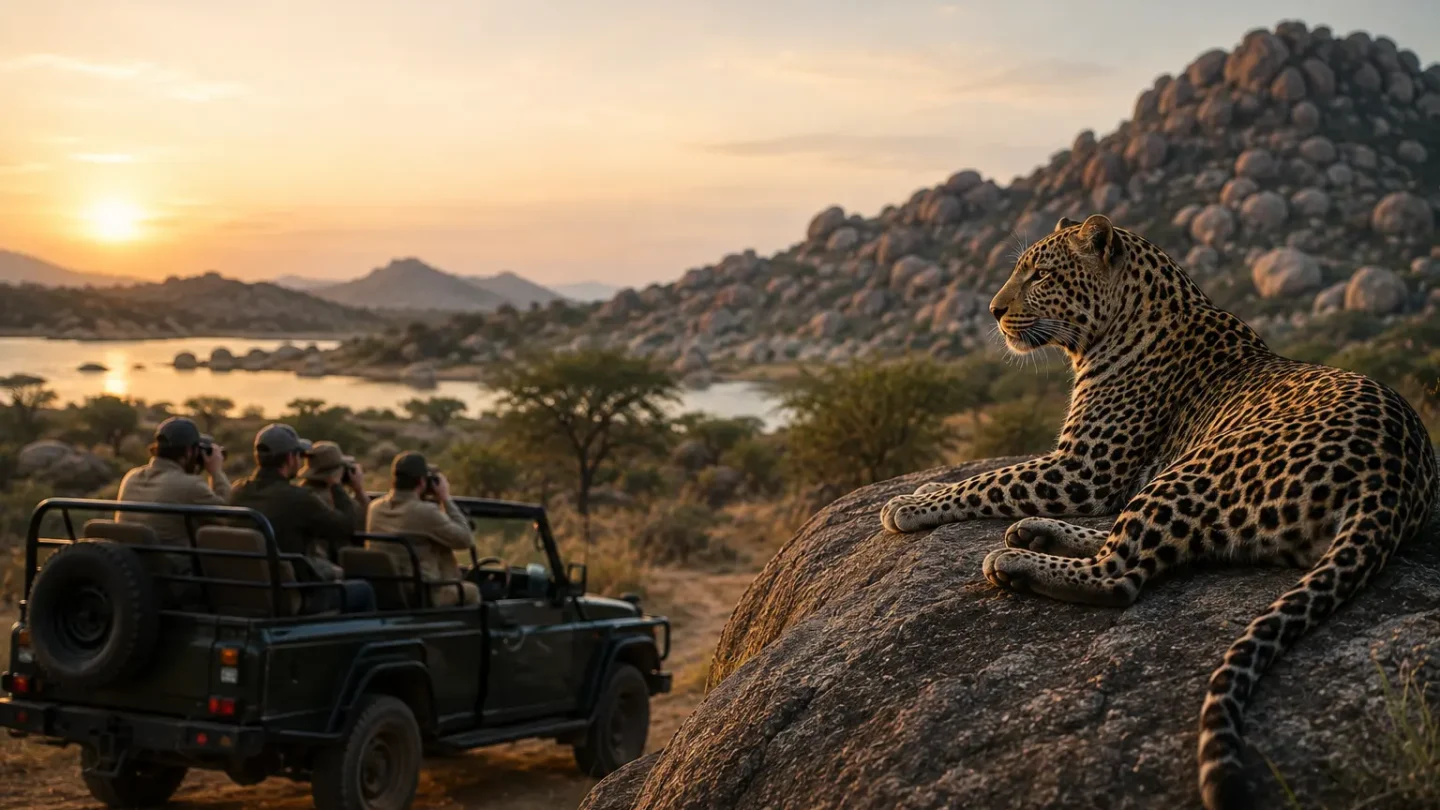
Most wildlife trips in India follow a familiar pattern. You enter a gate, drive into thick forest, and hope something walks across the track. Jawai does not work that way.
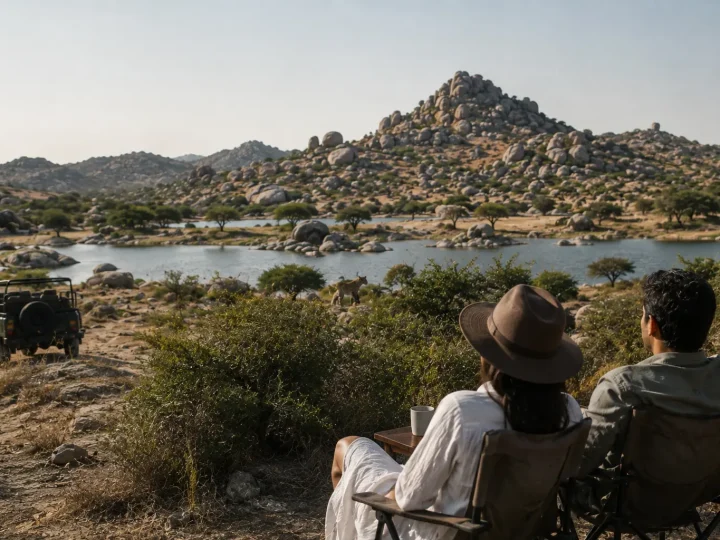
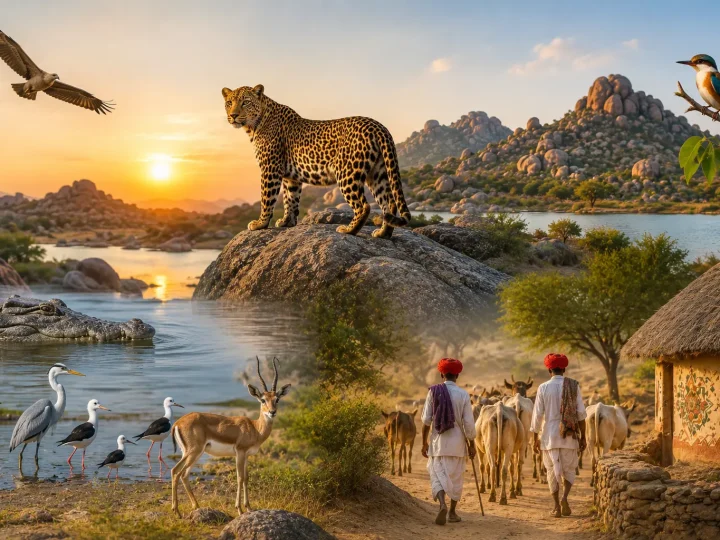
Here, in Rajasthan’s Pali district, the landscape is open and rocky. Huge granite hills rise straight out of farmland. Shepherds move their goats along the same paths that leopards use after dark. Villages, temples, cattle and wild animals share the same ground, and have done so for generations.
That coexistence is the real story of a Jawai leopard safari. You are not entering a sealed-off jungle. You are driving through a living, working landscape where leopards happen to live in the caves above.
This guide covers what the safari actually involves, how sightings work, what to carry, how booking usually happens, and how to plan your days so the trip feels relaxed rather than rushed. One thing to be clear about from the start: no one can promise you a leopard.
What Is a Jawai Leopard Safari?
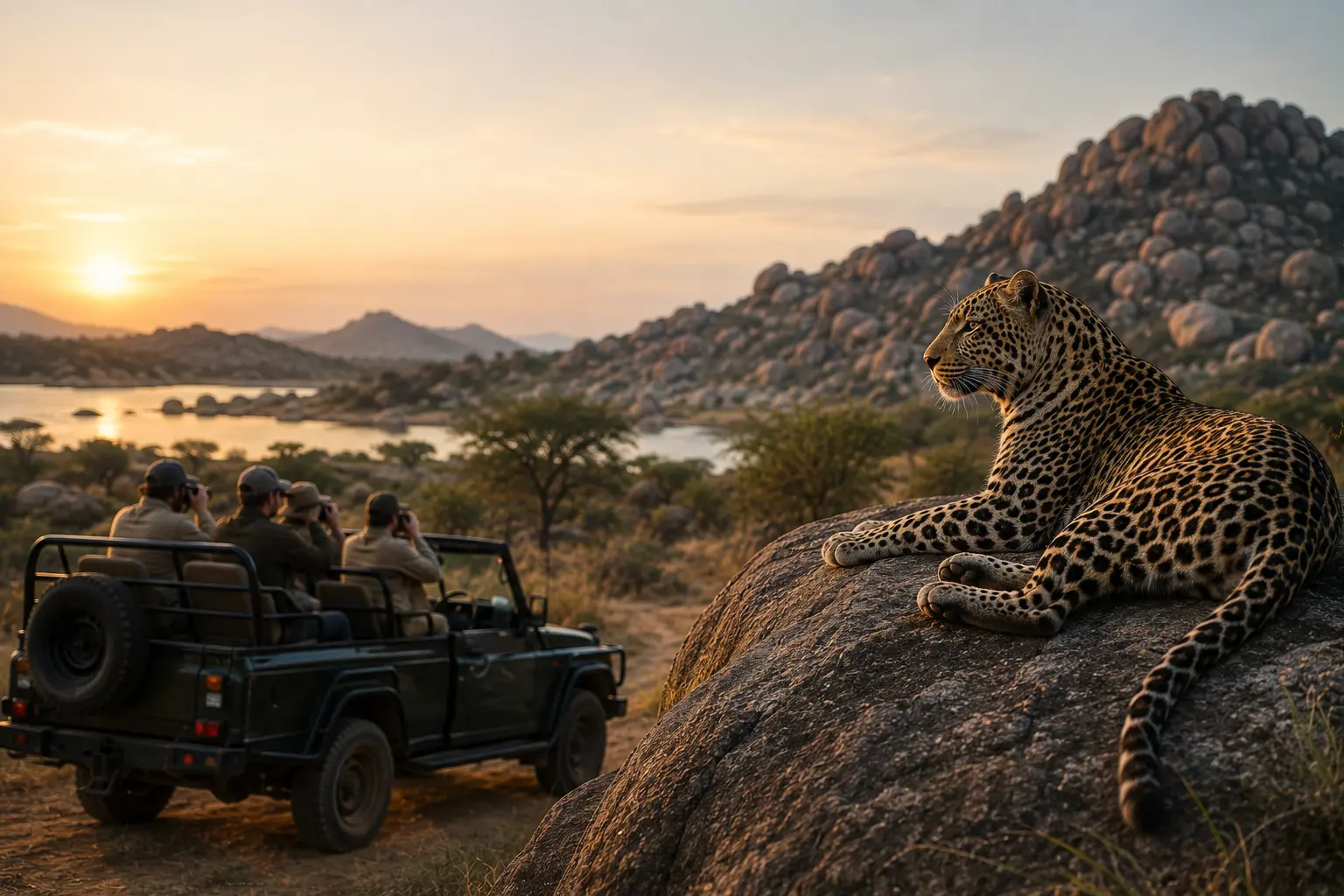
A Jawai safari is a guided drive in an open 4×4 vehicle across the rocky terrain around Jawai Bandh, the dam that gives the area its name. Drives usually last around two to three hours and run in the early morning and again in the late afternoon.
The area is officially protected as the Jawai Bandh Leopard Conservation Reserve, notified by the Rajasthan government in February 2010 to protect the region’s cave-dwelling leopards. The core reserve is small — under 20 square kilometres — but the wider landscape of hills, scrub, farmland and reservoir edges that leopards move through is much larger.
This is the key difference from a park like Ranthambore or Kanha. There is no single entry gate with a fixed grid of forest roads. Safari routes run across a mix of forest land, revenue land and village land. Your vehicle spends as much time near fields and cattle sheds as it does near wilderness.
What can you realistically expect? A long, slow drive with plenty of stopping. Time spent scanning cliff faces with binoculars. Conversations with your guide about which leopard was seen where, and when. Sometimes a sighting arrives in the first twenty minutes. Sometimes it does not come at all.
Why Is Jawai Famous for Leopards?
The granite is the reason.
The hills around Jawai are ancient volcanic rock, weathered over millions of years into rounded boulders with deep gaps, overhangs and caves between them. For a leopard, this is close to ideal. The caves stay cooler than the open ground, they are hard for people to reach, and they give a mother a safe place to raise cubs.
From high on a hill, a leopard can also watch everything below — who is moving, where the goats are, when it is safe to come down. Leopards are naturally secretive and adaptable, and this terrain suits both traits.
The second reason is food and water. The Jawai Dam, built across the Jawai river (a tributary of the Luni) in the 1950s, created a reservoir that holds water in an otherwise dry region. Water attracts birds, livestock and wild prey. Around the hills, farmland and grazing land support antelope, hares, peafowl and domestic animals.
The third reason is human. The Rabari, a traditional pastoral community, have lived alongside these leopards for generations. Their attitude has historically been one of tolerance rather than conflict — leopards are often linked to local temples and folk belief. That tolerance is a large part of why leopards here have not been pushed out.
None of this makes Jawai a zoo. These are wild animals in a shared landscape, and their behaviour is their own.
What Is a Jawai Leopard Safari Really Like?
Getting ready. Morning drives start early — often before sunrise, with tea or coffee at the camp. Dress in layers. Even in warm months, the wind in an open vehicle before dawn is cold.
Meeting your guide. This matters more than anything else on your booking sheet. Good Jawai guides and drivers are usually local. They know individual leopards by sight, they know which hill a female with cubs has been using, and they know the difference between a fresh alarm call and background noise. Ask questions. Most of them enjoy explaining.
Driving out. The vehicle climbs and drops across rough tracks between boulders. The drive itself is part of the appeal — the rock formations, the light on the granite, the village life going past. Keep the camera accessible from the start.
Reading the signs. Your guide will be watching for pugmarks in soft ground, fresh scat, langur or peafowl alarm calls, and the reaction of grazing livestock. A leopard can be sitting fifty metres away, completely still, and you will not see it until it moves. Signs of presence are common. Sightings are not the same thing.
Waiting. This is the part first-time visitors underestimate. Your vehicle may park below a cave mouth and simply wait, engine off, for twenty or thirty minutes. Learning to enjoy this is what separates a good safari from a frustrating one. Watch the birds. Listen.
Heading back. Morning drives end as the day heats up. Evening drives wind down before dark — under current rules, safari activity is not permitted after 7 pm, so the vehicle turns for home while there is still light.
Morning vs Evening Safari in Jawai
Neither is reliably better. They simply offer different things.
Morning safari
- Cool, still air and low, soft light for the first hour
- Good time for birds around the reservoir and fields
- Leopards may still be visible near cave entrances before settling in for the day
- Generally the more comfortable option in warmer months
Evening safari
- Warm side-light on the granite, which many photographers prefer
- Leopards often become more active as the day cools
- Village life is visible — herds returning, smoke from kitchens
- Ends earlier than it once did, since night driving and spotlights are no longer allowed
If you have time for both, take both. The landscape looks like a different place at each end of the day, and doubling your drives is the single most practical thing you can do to improve your chances.
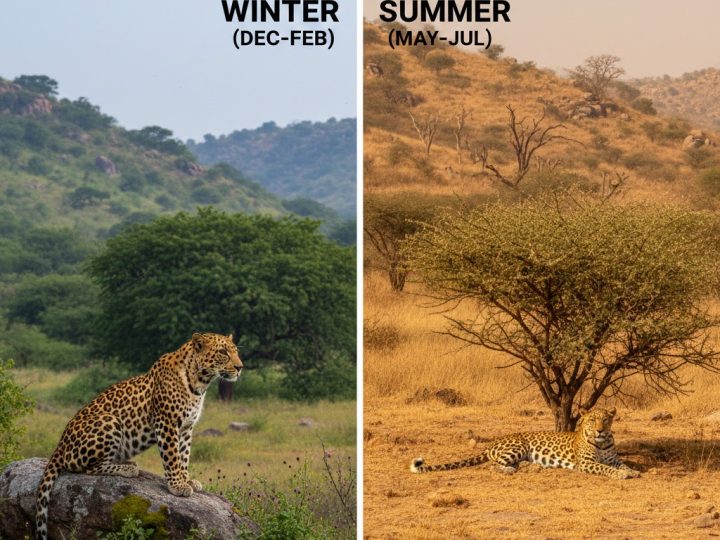
For seasonal planning — when the weather is most comfortable and how sightings vary through the year — see our guide to the best time to visit Jawai for leopard sightings.
What Wildlife Can You See in Jawai?
Leopards get the headlines, but they are not the whole picture. On a given drive you might see:
- Leopards — the main draw, most often on or near rocky hills
- Mugger crocodiles — basking along the edges of Jawai Bandh
- Striped hyena and jackal — shy, usually seen at the edges of the day
- Indian gazelle (chinkara), nilgai and wild boar — in scrub and farmland
- Langur, peafowl, mongoose and hares — common and often the first to signal that a predator is nearby
- Birds — this is Jawai’s underrated strength. The reservoir draws migratory waterfowl in winter, including flamingos in some years, along with cranes, storks, eagles and a long list of resident species
Sightings vary enormously by season, water level, time of day and luck. A birder can have an excellent morning without seeing a single leopard. That is worth remembering when you set your expectations.
The dam itself is worth a separate visit outside safari hours — more on that in our piece on Jawai Bandh.
How Does Jawai Leopard Safari Booking Work?
There is no single national booking portal for Jawai the way there is for some tiger reserves. In practice, most visitors book in one of two ways:
Through your resort or camp. This is the simplest route. Your stay coordinates the vehicle, the guide, the timing and the pickup. If a drive is cancelled or shifted, they handle it.
Through a local safari operator. Independent operators run drives for visitors staying elsewhere. Availability varies, especially on weekends and holidays.
A few practical points:
- Confirm early. Vehicle numbers are limited, and peak-season weekends fill up.
- Tell them your group size. Vehicles are typically shared six-seaters unless you book a private one, which costs more.
- Ask exactly what is included — vehicle, guide, permit, refreshments — before you pay.
- Expect variation in price. Safari cost in Jawai depends on the operator, whether the vehicle is private or shared, the season, and whether it is bundled into a package. Anyone quoting you a single fixed national rate is guessing.
Rules are currently changing, so verify before you travel. Following a Rajasthan High Court order in a public interest litigation, the state forest department has drafted a Standard Operating Procedure for tourism across the Jawai landscape. Reported measures include restricting safari and wildlife-spotting activity to roughly 6 am to 7 pm, prohibiting night safaris, drones, spotlights and baiting, and requiring safari vehicles to be registered with a coordination committee and fitted with approved GPS tracking. The court has also asked the state to consider whether Jawai should be formally declared a sanctuary.
Implementation is ongoing. Timings, vehicle rules, permitted zones and prices may all differ by the time you visit — always reconfirm with your resort or operator close to your travel dates.
How Many Safaris Should You Take in Jawai?
First-time visitors: three or four drives across two nights is a sensible baseline. It gives you both morning and evening light, and enough attempts that one quiet drive does not define the trip.
Photographers: budget more. Four to six drives over three nights, ideally in a private vehicle so you control positioning and how long you wait. Serious wildlife photography is mostly patience.
Couples: two nights with three drives usually works well, leaving space for the dam, a village walk and an unhurried evening.
Families with children: shorter and fewer is better. Two drives with a break between them keeps everyone comfortable. Small children get restless during long waits, and a restless vehicle is not a good vehicle for sightings.
The logic is simple. Each drive is an independent chance. More drives means more chances — but it is still not a guarantee, and no reputable operator will tell you otherwise.
What Should You Carry on a Jawai Safari?
- Comfortable clothes in muted colours — olive, khaki, grey, brown
- A light jacket or fleece for early mornings and winter evenings
- Cap or hat, and sunglasses
- Sunscreen
- Water bottle
- Binoculars (genuinely worth it here — much of the watching is distant)
- Camera with your longest lens, plus a spare battery and memory card
- Power bank
- Closed shoes
- A small dust cloth or cover for your camera; the tracks are dry and dusty
Skip perfume and strong deodorant, and leave loud, bright clothing behind.
Jawai Leopard Safari Photography Tips
Bring a telephoto lens if you own one — 300mm or longer is useful, and a wide-angle is worth having too, because the granite landscape photographs beautifully on its own.
Beyond gear:
- Move slowly. Sudden movement in the vehicle is more disruptive than sound.
- Set your camera up before the sighting, not during it. Check ISO and shutter speed while you are still driving.
- Do not use flash on wildlife.
- Keep your distance. If the animal changes its behaviour because of you, you are too close.
- Follow your guide’s instructions on where the vehicle stops. They are reading the animal, not just the view.
- Never ask a driver to move closer, cut off an animal’s path, or follow one that is walking away.
- Put the camera down for a few minutes. A leopard watching you from a rock is worth seeing with your own eyes.
Responsible Wildlife Tourism in Jawai
Jawai’s coexistence model is unusual and fragile. Crowding, noise and off-road driving have already prompted regulatory action. How visitors behave genuinely matters here.
- Do not feed any animal, wild or domestic
- Keep voices low and phones silent during a sighting
- Never ask your driver to chase, block or bait wildlife
- No drones, no spotlights, no playing recorded animal calls
- Stay in the vehicle unless your guide says otherwise
- Ask before photographing people, homes or livestock in the villages
- Carry your litter back with you — including tissues and bottle caps
- Support local guides, local food and local crafts where you can
If a sighting is already crowded, the responsible choice is to wait your turn or move on.
Where Should You Stay for a Jawai Safari?
Your choice of stay affects your safari more in Jawai than in most destinations, because your accommodation is usually also your safari operator.
What actually makes a difference:
- Safari coordination handled in-house, so timings, vehicles and guides are one conversation instead of three
- Guides and trackers who are local, with real knowledge of the terrain and individual animals
- Comfortable rooms or tents — you are getting up before dawn and coming back dusty
- Reliable meals at odd hours, including early breakfast and late dinner
- Quiet surroundings, ideally with open views towards the hills
- Other things to do between drives: a village visit, a birding walk, a spot to watch the sunset
A comfortable base changes the rhythm of the trip. When your driver knows the terrain and your room is waiting after a cold morning drive, three days in Jawai feel restful instead of exhausting. If you are weighing options in that direction, our list of luxury resorts in Jawai covers what different properties offer and how they handle safaris.
Planning the journey itself? See how to reach Jawai from Delhi, and for evenings after the drive, what Jawai is like after dark and local food worth trying.
Is a Jawai Leopard Safari Worth It?
It depends on what you want from a trip.
If your measure of success is a guaranteed close-up of a big cat, Jawai may frustrate you. Sightings here are real but unpredictable, and the drives involve a lot of waiting.
If you want a landscape that looks like nowhere else in Rajasthan, a genuine chance at wild leopards, excellent birding, a working village culture that has not been staged for tourists, and a slower pace than the standard Rajasthan circuit — then yes, it is worth the detour.
Jawai tends to suit photographers, birdwatchers, repeat India travellers, and couples who want quiet. It suits people who are happy sitting still for half an hour watching a cliff face. It suits a two- or three-night stay far better than a rushed overnight.
Frequently Asked Questions
Is Jawai good for leopard sightings? Jawai is well known for leopards, and the open rocky terrain makes them easier to spot than in dense forest, since animals are often visible on exposed hillsides. Sightings still depend on season, time of day, weather and luck. Multiple drives improve your chances, but no operator can promise a sighting.
What is the best time of day for a Jawai safari? Both morning and evening drives work. Mornings are cooler with soft light and good bird activity. Evenings offer warm light on the granite and often more animal movement as temperatures drop. If you can, do both — the landscape and wildlife behave differently at each end of the day.
Are leopard sightings guaranteed in Jawai? No. These are wild animals in a large, open landscape and there is no guarantee on any drive. Be cautious of any operator advertising guaranteed or “100%” sightings. A realistic approach is to book more than one safari and treat any sighting as a bonus rather than the whole purpose.
How long does a Jawai safari take? A single drive usually runs about two to three hours, including travel to and from the safari area. Morning drives typically start around sunrise; evening drives end before dark, as activity beyond the permitted evening cut-off is not allowed. Confirm exact timings with your resort or operator, as rules are being revised.
What should I wear for a Jawai safari? Comfortable clothes in muted natural colours, closed shoes, a cap and sunglasses. Add a jacket or fleece for early mornings and winter evenings — open vehicles get cold before sunrise. Avoid bright colours, white, strong perfume and anything that rustles loudly.
Can children go on a Jawai leopard safari? Generally yes, though policies vary by operator, and some restrict very young children on shared vehicles. Long waits and rough tracks can be tiring for small kids. Two shorter drives with a rest in between usually works better than a packed schedule. Check age policies when booking.
How many safaris should I take in Jawai? Three to four drives across two nights is a reasonable plan for most first-time visitors. Photographers often want more. Each drive is a separate opportunity, so more attempts genuinely help — while remembering that quantity still does not guarantee a sighting.
Can I combine a leopard safari with other Jawai experiences? Yes, and it is worth doing. Between drives you can visit Jawai Bandh for crocodiles and waterbirds, walk to a Rabari settlement, visit local temples in the hills, or simply watch the sun set behind the granite. These add a lot to a trip that might otherwise depend entirely on one animal.
Before You Go
A Jawai safari rewards patience more than luck. Give yourself at least two nights, take more than one drive, listen to your guide, and let the landscape be a reason to come rather than just a backdrop to a leopard sighting.
Because your stay usually organises your safaris, choosing well simplifies everything else. If you would like to see how different properties handle drives, guides and the hours in between, our overview of where to stay for a Jawai safari is a good place to start planning.
Safari timings, prices, vehicle rules and permitted areas in Jawai are currently under review following a Rajasthan High Court order and a draft Standard Operating Procedure from the Rajasthan Forest Department. Please confirm all current details with your resort, operator or the Rajasthan Forest Department before travelling.