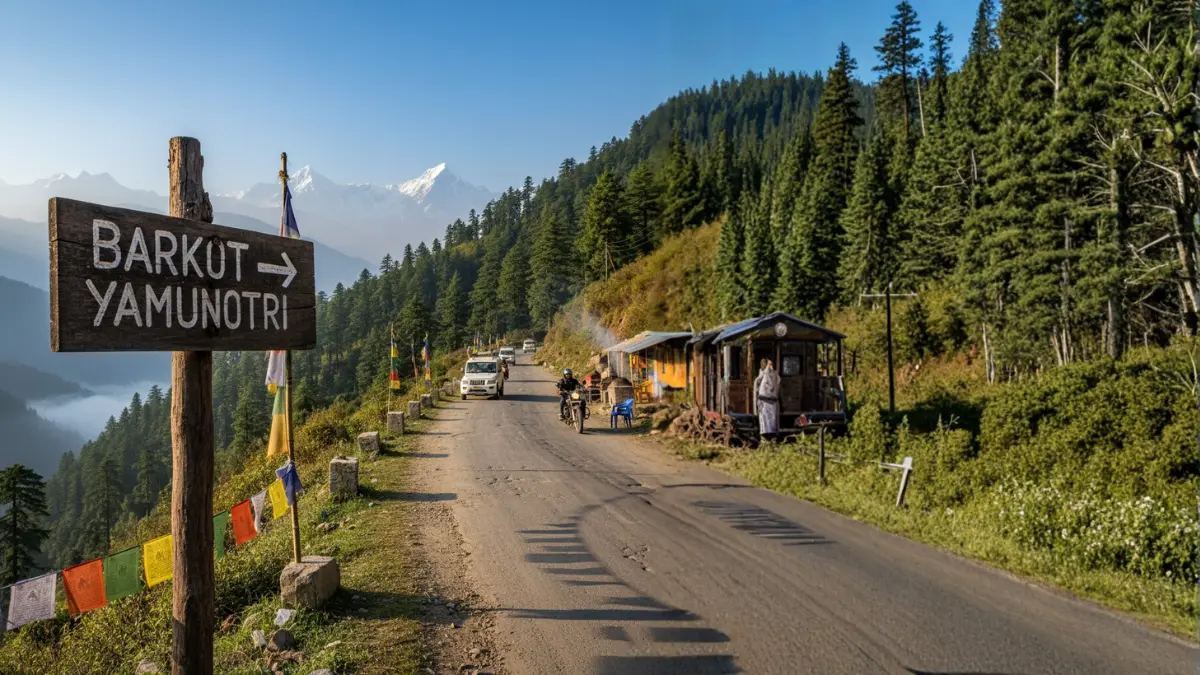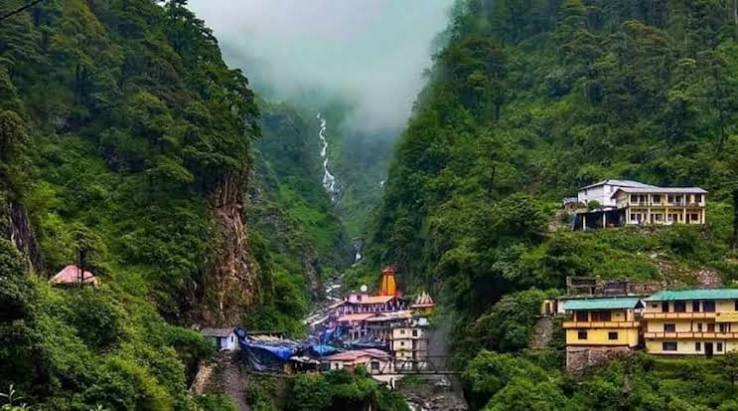
Almost everyone who comes to Barkot arrives after dark and leaves before sunrise. Sleep, tea, Yamunotri, gone. We watch it happen from our property here every single day of the season, and it is a bit of a waste, because Barkot is one of the few Char Dham halts that is genuinely worth a day of its own.
The town sits at about 1,220 m on the bank of the Yamuna in Uttarkashi district. Bandarpoonch fills the skyline on a clear morning. The valley around it is all apple and apricot orchards. And because almost nobody stops, you get places to yourself that would be crawling with people in Mussoorie or Rishikesh.
Here is what we send guests off to see, sorted by how far you have to go.
In and around town — no vehicle needed
1. The Yamuna riverfront at dawn
The Yamuna here is young, fast and very cold. There is no built-up ghat, no shops, no crowd. Just water over rounded boulders and mist coming off it until about 7 AM.
Walk down early with tea and sit for half an hour. This is the single best free thing to do in Barkot and it is the thing guests mention when they check out. Go before your Yamunotri day rather than after, when your legs will not want to walk anywhere.
2. Bandarpoonch from the ridge above town
Bandarpoonch, the “monkey’s tail”, dominates the horizon north-east of Barkot. Any of the small footpaths climbing out of town towards the terraced fields will give you an open view within twenty minutes of walking.
The window is narrow. On most days the peak is clean between roughly 5:30 and 7:30 AM and again for a short spell before sunset, and clouds close in through the middle of the day. In the monsoon you may not see it at all for a week.
3. Barkot market
Small, one main street, and worth an hour in the evening. What to look for: locally pressed apple juice and jam, rajma from the upper villages, Garhwali red rice, hand-knitted woollens, and walnuts and apricot kernels in autumn.
Prices are what locals pay. This is not a tourist market, which is exactly the point. Carry cash — most shops here do not take cards.
4. Apple and apricot orchards
The Yamuna valley around Barkot is orchard country. Apricots come in through June and July; apples run from late August into October, which happens to be when the yatra crowds have thinned out and the weather is at its best.
Several orchards on the Nainbagh and Damta side will let you walk through and buy fruit straight off the tree if you ask politely. We can point you to the ones that are used to visitors.
A short drive out
5. Hanuman Chatti (22 km)
On the Yamunotri road, where the Hanuman Ganga meets the Yamuna. Most people pass straight through it at 6 AM without a glance. It is a good stop on a lazy afternoon — the confluence is pretty, there are a few tea shops, and the trailhead for the old Dodital and Darwa Top routes starts from around here.
6. Kharsali village (about 35 km)
This is the one we push hardest, and hardly anyone does it.
Kharsali sits across the river from Janki Chatti and is the winter home of the Yamuna. When the Yamunotri temple closes around Bhai Dooj, the deity is carried down to Kharsali and stays here through the winter, which means the village is a live pilgrimage site for six months of the year when the actual dham is shut and snowed in.
The Someshwar Mahadev temple here is old, built in the traditional Garhwali style in stone and deodar, and the carving is worth a proper look. The village itself is stone houses, slate roofs, and thermal springs. Kharsali also has the helipad used by the Yamunotri chopper service.
If you are already driving to Janki Chatti, adding Kharsali costs you almost nothing.
7. Rafting on the Yamuna
Not Rishikesh-scale, and not always running — it depends on water levels and on which operators are active that season. But when it is on, the stretches near Barkot give you an easy, scenic float with genuinely nobody else on the water.
Check locally before you build a day around it. Ask your hotel rather than booking blind online, because operators here come and go between seasons.
Full day trips
8. Mot Bugyal trek
A high meadow above the Yamuna valley that almost no trekking company sells, which is why it is still quiet. It is a manageable day out for anyone with reasonable fitness and it gives you the Bugyal experience — open grassland, big views, sheep — without the queue you would find on Kedarkantha in December.
We have written a full guide to the Mot Bugyal trek if you want the route detail.
9. Lakhamandal (about 70 km)
An ancient Shiva temple complex on the Dehradun side, with a yard full of loose stone lingams and sculpture fragments and a local legend tying the site to the Pandavas and the lac palace of the Mahabharata. Archaeologically it is a genuinely interesting spot and it is almost empty most days.
It is a long half-day round trip on winding road, so only take it on if you have a full free day.
How to fit this into a Char Dham itinerary
Most people run Barkot as a single night. If you can give it two, here is how we would spend them:
Evening of arrival — Market, dinner, early sleep.
Day 1 — Yamunotri. Leave at 5 AM, back by evening. Add Kharsali on the way back if you are down from the trek by 2 PM. Our Barkot to Yamunotri route and timings guide has the full day plan.
Day 2 — Slow morning. River at dawn, orchards or Mot Bugyal depending on how the legs feel, then drive on to Uttarkashi for Gangotri in the afternoon.
That extra day costs you very little and it is the difference between having done Yamunotri and having actually seen this valley.
Best time to visit Barkot
| Period | What it’s like |
|---|---|
| April – June | Yatra season, pleasant days, cold nights, town at its busiest |
| July – August | Monsoon, apricots, landslide risk on the roads |
| September – October | Clear skies, apple harvest, thin crowds — the best window |
| November – March | Temple closed, very cold, but Kharsali is active and the valley is beautiful |
Barkot itself does not shut in winter, which surprises people. If you want the valley without a single other tourist in it, come in November.
Frequently asked questions
Is Barkot worth staying an extra day? Yes, if you want more than a temple queue out of your trip. One night is enough purely as a yatra halt; two lets you see Kharsali, the orchards and the river properly.
What is Barkot famous for? Being the main base town on the Yamunotri route, and for its apple orchards and views of Bandarpoonch. It is a working hill town rather than a tourist hill station, which is most of its appeal.
How many days do you need in Barkot? Two nights covers Yamunotri plus a relaxed day locally. Three if you want to add Mot Bugyal or Lakhamandal.
Is Barkot good for families with elderly parents? Very. At 1,220 m there are no altitude issues, the town is flat and walkable, and everything on this list except the treks is easy going.
Are there things to do in Barkot in winter? Kharsali is the main one, since the Yamuna deity resides there through winter. Add snow views, empty roads and orchards without leaves. Carry serious woollens.
Where to base yourself
All of this works better if you are not rushing. Our resort in Barkot has cottages and luxury tents with hot water, an in-house kitchen and a bonfire in the evening — and a team that knows which orchards welcome visitors and whether the rafting is running this week.
If you are still weighing options in town, our guide to the best resorts in Barkot for a Yamunotri yatra base covers the range across budgets.
Call 011-408-44995 or write to info@adhvantaindia.com and we will build the Barkot leg around whichever of these you actually want to do.