Most people pack for Rann Utsav thinking about the daytime: sunny, dry, pleasant. Then the sun goes down over the White Rann, the wind picks up across the salt flat, and they realise the light jacket in their bag isn’t going to cut it.
The Kutch desert is a place of two climates in one day. Afternoons can feel like early summer, and nights can dip close to single digits. Knowing what to pack for Rann Utsav comes down to one thing: plan for both.
Here’s what the weather actually looks like each month of the festival, and a packing checklist built around it.
Rann of Kutch Weather: Month-Wise Breakdown
Rann Utsav typically runs from November to February. Temperatures below are approximate and can shift a few degrees year to year.
November
November is the gentlest month to visit. Days are warm, around 28–32°C, and nights settle at roughly 15–18°C. The salt flat is still drying out early in the month, so the white surface becomes brighter as the weeks go on.
What this means for packing: Cotton clothes for the day, one medium-weight jacket or sweatshirt for the evening. You won’t need heavy woollens.
December
This is when the cold arrives. Rann of Kutch weather in December brings daytime highs of about 24–27°C, but nights drop to around 8–12°C, and out on the open salt flat with the wind, it feels colder. December is also peak season, with Christmas and New Year crowds.
What this means for packing: Proper layers. A thermal inner, a fleece or sweater, and a windproof jacket for evenings on the Rann.
January
January is the coldest month. The Rann of Kutch weather in January sees days around 22–26°C and nights that can fall to 5–8°C, occasionally lower in the open desert around Dhordo. The morning chill lingers until the sun is well up.
What this means for packing: Your warmest layers. Thermals, a heavy jacket, a woollen cap, gloves and warm socks. If you’re heading out for sunrise or a full moon night, dress like you’re going somewhere genuinely cold, because you are.
February
Temperatures start climbing again. Days are around 27–30°C and nights around 12–15°C. It’s a comfortable month with thinner crowds towards the end of the season.
What this means for packing: Similar to November, with one warmer layer for late evenings.
Quick reference
| Month | Day temp (approx.) | Night temp (approx.) | Warm layers needed |
|---|---|---|---|
| November | 28–32°C | 15–18°C | Light |
| December | 24–27°C | 8–12°C | Medium to heavy |
| January | 22–26°C | 5–8°C | Heavy |
| February | 27–30°C | 12–15°C | Light to medium |
Rann Utsav Clothes: What to Wear
The trick with Rann Utsav clothes is layering, not bulk. You’ll be peeling layers off by noon and piling them back on by 6 pm.
For the day:
- Light cotton or linen shirts, full-sleeved if possible to protect against the sun
- Comfortable trousers or loose pants
- A wide-brimmed hat or cap
- A scarf or stole, useful for sun, dust and wind
For the evening and night:
- Thermal innerwear (essential in December and January)
- A fleece, sweater or hoodie
- A windproof jacket; the wind on the salt flat is what makes it feel colder than the thermometer says
- Woollen cap and gloves
- Warm socks
A good tip: if you plan to attend the cultural evenings or wear traditional clothes for photos, carry a shawl you can throw over your outfit. It keeps you warm without hiding what you’re wearing.
Why You Need Sunglasses in the White Rann
This one catches people off guard. The White Rann is a vast, flat sheet of salt, and during the day it reflects sunlight straight back at you, a bit like snow does. Walking out on it without eye protection for an hour can leave your eyes strained and watering.
Carry a pair of polarised UV-protection sunglasses. Polarised lenses cut the glare off the salt far better than regular tinted ones. Add sunscreen (SPF 30 or higher) and lip balm too; the dry air and reflected light will dry out your skin quickly.
Footwear for the Rann
You’ll walk more than you expect: around the tent city, out onto the salt flat, through Bhuj’s markets, and possibly up to Kalo Dungar.
- Comfortable closed walking shoes or sneakers for the Rann and sightseeing. Salt crust can be sharp in places and gets into open footwear.
- A pair of slippers or sandals for the tent and short walks within the camp.
- Warm socks for night outings.
Skip heels and delicate footwear. The ground is uneven and salt can stain leather.
ID and Permits: Don’t Leave These Behind
The White Rann is close to the international border, so you need a permit to enter. Permits can be obtained online or at the Bhirandiyara checkpoint on the way, and you’ll need valid government photo ID for every person in your group.
Carry:
- Original government photo ID (Aadhaar, passport, voter ID or driving licence) for each traveller
- Photocopies and digital copies on your phone as backup
- Passport and visa for foreign nationals
- Your booking confirmation for accommodation
Keep these in a small pouch you can reach easily, as ID may be checked at the checkpoint.
Photography Gear for Full Moon Nights
A full moon night on the White Rann is the reason many people time their whole trip. The moonlight turns the salt flat silver, almost glowing, and it’s one of the most photographed sights in India. (Read our full moon at Rann Utsav guide for dates and the best viewing spots.)
If you want to capture it properly, pack:
- A sturdy tripod. Night shots need long exposures, and handheld won’t work. The wind on the Rann will shake a flimsy one.
- A wide-angle lens to take in the scale of the salt flat and sky.
- Spare batteries. Cold drains batteries fast. Keep spares in an inside jacket pocket, close to your body.
- A remote shutter or intervalometer (or use your camera’s timer) to avoid shake.
- Lens cloth and a blower. Fine salt dust settles on everything.
- A headlamp with a red-light mode so you can see your settings without ruining your night vision or other people’s shots.
- A polarising filter for daytime shots to control glare off the salt.
Phone photographers: most recent phones have a night mode that works well here. A small phone tripod makes a big difference.
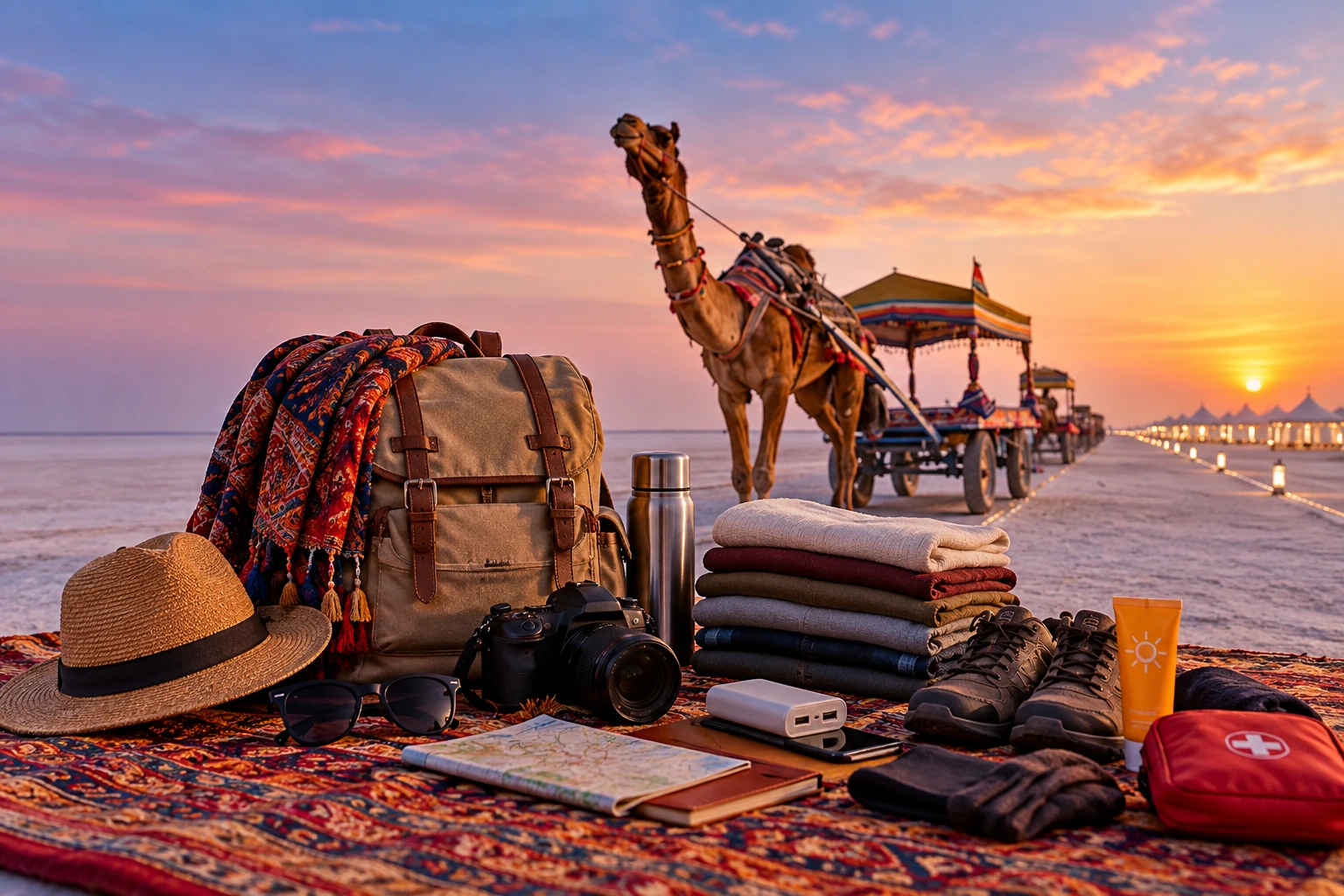
The Complete Rann Utsav Packing Checklist
Clothing
- Cotton shirts and trousers for daytime
- Thermal innerwear (Dec–Jan)
- Fleece or sweater
- Windproof jacket
- Woollen cap, gloves, warm socks
- Scarf or stole
- Shawl for cultural evenings
Sun protection
- Polarised UV sunglasses
- Sunscreen SPF 30+
- Lip balm and moisturiser
- Hat or cap
Footwear
- Closed walking shoes
- Slippers or sandals
Documents
- Original photo ID for every traveller
- Copies of ID (paper and digital)
- Passport and visa (foreign nationals)
- Booking confirmations
Photography
- Camera and wide-angle lens
- Tripod
- Spare batteries and memory cards
- Remote shutter
- Lens cloth and blower
- Headlamp with red light
Other essentials
- Reusable water bottle
- Power bank
- Basic medicines and any personal prescriptions
- Some cash (network and card machines can be patchy near the Rann)
- Small daypack
A Note on Where You Stay
Your tent is your base after long days out on the Rann, so comfort matters. Our tents at Rann Utsav are air-conditioned, so you’ll rest easy inside whatever the weather. Just remember the cold hits the moment you step outside for a sunrise or a full moon walk, so keep your warm layers ready by the door.
Plan Your Trip
Once your bag is sorted, the rest is easy. Explore our Rann Utsav packages for stays, meals, sightseeing and cultural programmes bundled together, so you can focus on the experience rather than the logistics.
Frequently Asked Questions
What is the Rann of Kutch weather in December?
Days are pleasant at around 24–27°C, while nights drop to roughly 8–12°C and feel colder on the open salt flat due to wind.
Is January too cold for Rann Utsav?
January is the coldest month, with nights around 5–8°C, but it’s very manageable with thermals, a heavy jacket and warm accessories. Days remain sunny and comfortable.
What clothes should I wear for Rann Utsav?
Light cotton layers for the day and warm layers (thermals, fleece, windproof jacket) for the evening. Layering works better than one heavy outfit.
Do I need sunglasses at the White Rann?
Yes. The salt reflects strong sunlight, so polarised UV sunglasses are strongly recommended.
What documents do I need for the White Rann permit?
A valid original government photo ID for each traveller. Foreign nationals need their passport and visa.