Most people come to Kutch for the white desert. Then they come home talking about the villages.
The stalls at the Rann Utsav tent city are fine, but the best part of shopping in Rann Utsav is driving out to the places where the work is actually made. You sit on a charpai while a weaver works the loom, you watch someone draw a Rogan motif freehand with a metal stick, and you buy the piece from the person who made it. The price is usually better too.
Most of the Kutch handicraft villages sit within 10 to 80 km of Bhuj, so you can cover them over two or three days on your way to the Rann. Here is what each village is known for, what to buy, what you should expect to pay, and how to buy directly from artisans.
A note on prices: the ranges below are rough figures for the 2026 season. They vary with size, material and the artisan’s reputation, so use them as a guide, not a rate card.
Bhujodi: Handloom Weaving
Distance from Bhuj: about 8 km, just off the Bhuj–Anjar road
Bhujodi is the easiest place to start and probably the most rewarding. Almost every home in the weavers’ lane belongs to the Vankar community, and you will hear the clack of pit looms before you see them. The families have been weaving for generations, first for the Rabari and Ahir herders who wore their shawls, and now for buyers from around the world.
Walk in, say hello, and most families will happily show you the loom and the storeroom. There’s no pressure to buy, though it’s hard to leave empty-handed.
What to buy
- Woollen and merino shawls with the extra-weft motifs Bhujodi is known for
- Cotton and Kala cotton stoles (Kala is a hardy, rain-fed native cotton grown in Kutch)
- Handwoven dhurries and small rugs
- Blankets and throws, some made with camel or sheep wool
Rough prices
| Item | Price range |
|---|---|
| Cotton stole | ₹700 – ₹2,000 |
| Woollen shawl | ₹1,500 – ₹6,000 |
| Fine merino or award-winning weaver’s shawl | ₹6,000 – ₹20,000+ |
| Dhurrie / small rug | ₹2,000 – ₹12,000 |
While you’re here: Hiralaxmi Craft Park near the village has stalls from artisans all over Kutch. It’s handy if you’re short on time, though you’ll get more of the story buying inside Bhujodi itself.
Ajrakhpur: Ajrakh Block Printing
Distance from Bhuj: about 12 km, close to Bhujodi
Ajrakhpur is a young village with a very old craft. The Khatri families who practise Ajrakh moved here from Dhamadka after the 2001 earthquake damaged their water source, since block printing needs a lot of clean water. Today it’s the best place in India to buy authentic Ajrakh, and Kachchhi Ajrakh has had a GI tag since 2023.
Real Ajrakh is slow work. The cloth goes through well over a dozen stages of printing, resist-pasting, dyeing with indigo and madder, and washing, often over a couple of weeks. Ask to see the workshop. The drying yards with long lengths of indigo cloth are worth the visit alone.
Also, the Living and Learning Design Centre (LLDC) crafts museum is in Ajrakhpur. Budget an hour; it’s one of the best craft museums in the country.
What to buy
- Dupattas and stoles
- Sarees in cotton, modal and silk
- Unstitched fabric by the metre
- Bedsheets, table linen and cushion covers
Rough prices
| Item | Price range |
|---|---|
| Fabric per metre | ₹250 – ₹600 |
| Cotton dupatta | ₹800 – ₹2,500 |
| Cotton saree | ₹2,500 – ₹6,000 |
| Silk or modal saree (natural dye) | ₹6,000 – ₹20,000+ |
| Double bedsheet set | ₹1,800 – ₹4,500 |
Tip: Screen-printed “Ajrakh-style” fabric is sold everywhere, including in Bhuj markets. Genuine hand-block, natural-dye pieces show small irregularities in the print and have a slightly uneven depth of colour. If a price looks too cheap, it probably isn’t the real thing.
Nirona: Rogan Art, Copper Bells and Lacquerwork
Distance from Bhuj: about 40 km northwest
Nirona is the village to give a full morning to, because three different crafts live on the same few streets.
Rogan art is the famous one. Castor oil is boiled for hours into a thick paste, mixed with pigment, and then drawn onto cloth with a thin metal rod without the rod ever touching the fabric. Half the design is painted, then the cloth is folded to print a mirror image on the other side. Only a handful of families still practise it, with the Khatri family the best known. Abdul Gafur Khatri received the Padma Shri in 2019, and a Rogan Tree of Life piece was gifted to Barack Obama in 2014. Expect a queue at the Khatri workshop during peak season. It’s worth waiting for.
Copper bells are made by the Lohar families from scrap iron, coated in copper and brass, and tuned by hand. They were originally made for cattle. Ask them to ring a set for you; each one has its own note.
Lacquerwork is done by the Vadha community on a hand-powered lathe. Wooden spoons, rolling pins and small boxes get layered with bright colours and patterns while they spin.
Rough prices
| Item | Price range |
|---|---|
| Small Rogan piece (bookmark, small frame) | ₹500 – ₹2,000 |
| Medium Rogan frame / wall piece | ₹3,000 – ₹15,000 |
| Large Tree of Life | ₹20,000 upwards, often made to order |
| Single copper bell | ₹100 – ₹1,500 |
| Bell wind chime / set | ₹500 – ₹3,000 |
| Lacquer spoon, rolling pin or small box | ₹150 – ₹1,000 |
Tip: Rogan work takes days even for small pieces, so bargaining hard here is a bit unfair. The prices are what they are.
Hodka and Khavda: Pottery, Embroidery and Leatherwork
Distance from Bhuj: Hodka about 60 km, Khavda about 70 km north, both in the Banni region on the way to the White Rann
These two villages sit on the road to the Rann, so they fit neatly into the drive to Dhordo.
Khavda is where to go for pottery. The Kumbhar potters make red clay pots, bowls, lamps and water vessels, and the women of the family paint them with fine geometric patterns in black, white and ochre using twigs and simple brushes. The work is simple and lovely, and it’s some of the cheapest good craft you’ll find in Kutch.
Hodka is better known for embroidery and leatherwork than pottery. Meghwal and Halepotra women do fine mirror and thread embroidery, and the leather craftsmen make bags, pouches and footwear. The village also runs a community-owned stay with traditional round mud bhungas, if you want a night in Banni.
Rough prices
| Item | Price range |
|---|---|
| Small clay pot, diya or bowl (Khavda) | ₹50 – ₹300 |
| Large painted pot or vessel (Khavda) | ₹500 – ₹2,000 |
| Embroidered cushion cover (Hodka) | ₹400 – ₹1,500 |
| Embroidered wall hanging | ₹1,000 – ₹6,000 |
| Leather pouch or bag | ₹300 – ₹2,500 |
Tip: Pottery is fragile and doesn’t travel well in checked luggage. Buy smaller pieces, ask the potter to wrap them in cloth and newspaper, and carry them in your hand luggage.
How to Buy Directly from Artisans
Buying straight from the maker means more of your money reaches the family, and you get to hear how the piece was made. A few things that help:
Carry cash, but UPI mostly works. Most artisans accept UPI now, but mobile signal in Banni and near the Rann can be patchy. Keep some cash for Khavda and Hodka.
Bargain gently, if at all. A little negotiation is normal on bigger purchases, especially if you’re buying several pieces. But these are handmade items, often priced fairly already. Knocking ₹200 off a shawl that took a week to weave isn’t much of a win.
Ask questions. Natural dye or chemical? Handloom or powerloom? Who made it? Genuine artisans are happy to explain, and the answers tell you a lot about what you’re buying.
Ask about shipping. Many workshops in Bhujodi, Ajrakhpur and Nirona can courier larger items like rugs or bedsheet sets anywhere in India. Get a receipt and a phone number.
Visit in the morning. Artisans are working, the light is good for seeing colours, and you avoid the afternoon tour-group rush.
Be respectful with photos. Ask before photographing people, especially women in Banni villages. Most families are fine with photos of the work itself.
Suggested Shopping Route
If you’re staying in Bhuj, this works well over two days before heading to the Rann:
Day 1: Bhujodi in the morning, LLDC museum and Ajrakhpur in the afternoon. All three are within a few kilometres of each other.
Day 2: Drive to Nirona in the morning, then head north through Hodka and Khavda to the White Rann by evening for sunset.
If you’d rather not plan transport and village stops yourself, our Rann Utsav package from Bhuj includes guided visits to these craft villages, and our White Rann resort puts you close enough to Hodka and Khavda to visit without a long drive.
Shopping at the Rann Utsav Tent City
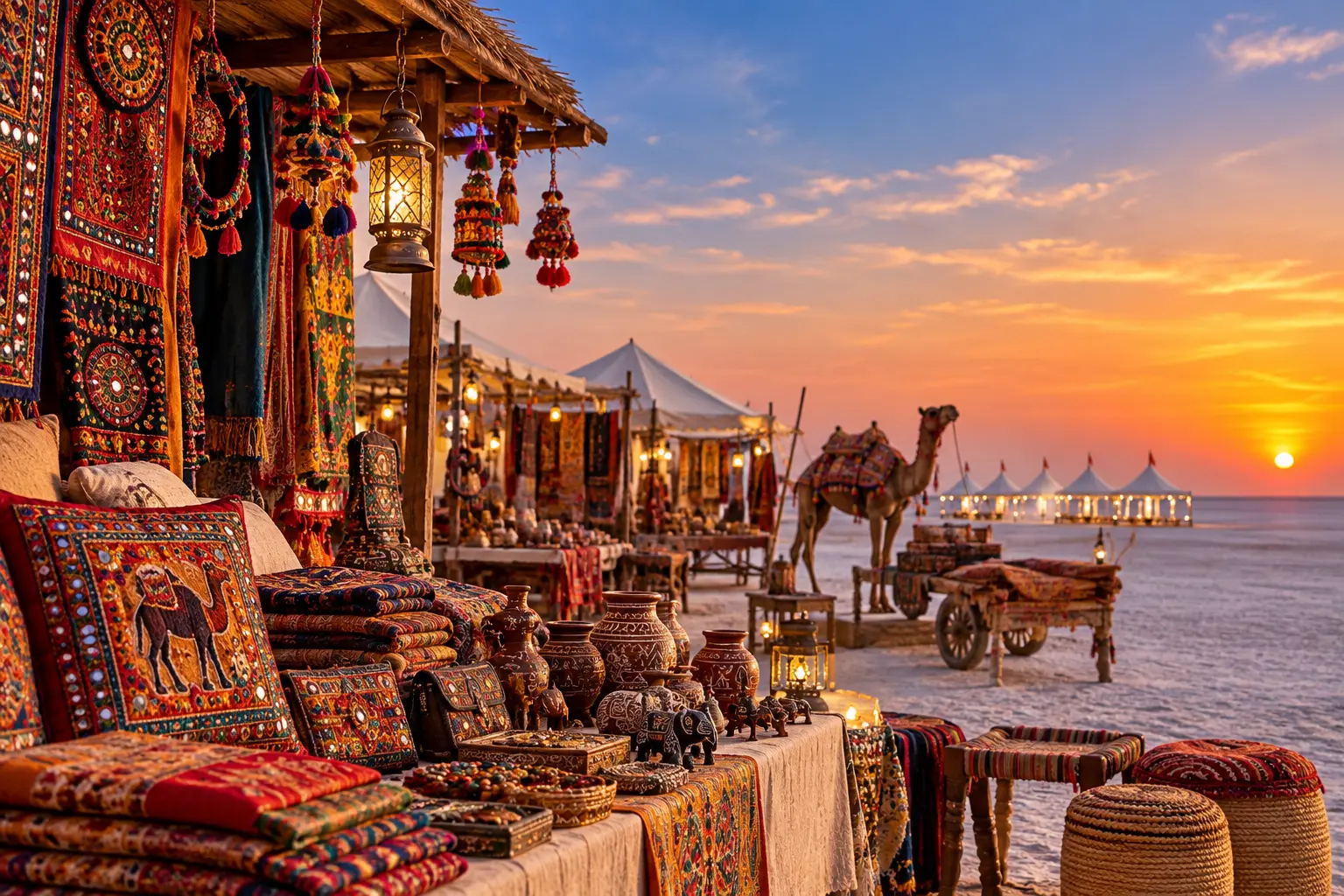
The Rann Utsav tent city at Dhordo has a crafts bazaar with stalls from across Kutch. It’s convenient if you missed a village or want to compare pieces side by side, and many artisans from Bhujodi and Nirona set up there during the festival. Prices are a bit higher than in the villages, and you lose the chance to see the work being made, but it’s a good backup.
Frequently Asked Questions
Which is the best village for shopping in Kutch?
It depends on what you want. Bhujodi is best for shawls and stoles, Ajrakhpur for Ajrakh fabric and sarees, Nirona for Rogan art and copper bells, and Khavda for painted pottery.
How far is Bhujodi from Bhuj?
Around 8 km, about 15 to 20 minutes by car.
Is Nirona Rogan art expensive?
Small pieces start at around ₹500, while larger framed works cost several thousand rupees. Big Tree of Life pieces can run past ₹20,000 because each one takes weeks.
How can I tell if Ajrakh is genuine?
Genuine hand-block Ajrakh has slight irregularities in the print, a deep but uneven colour from natural dyes, and the pattern shows through clearly on the back. Buying in Ajrakhpur itself is the safest option.
Can I visit the craft villages during Rann Utsav?
Yes. Rann Utsav runs through the winter months, which is also the best weather for village visits. Artisans are busiest then, so go early in the day.