Everything you need to know about dates, sacred ghats, rituals, and planning your journey to India’s most spiritually charged gathering in Maharashtra.
AT A GLANCE
| Detail | Information |
| Event Name | Nashik Simhastha Kumbh Mela 2027 |
| Also Known As | Nashik-Trimbakeshwar Kumbh Mela |
| Official Start | October 31, 2026 (Flag Hoisting) |
| Official End | July 24, 2028 (Flag Lowering) |
| Peak Bathing Months | August – September 2027 |
| Sacred River | Godavari |
| Primary Locations | Ramkund, Nashik & Kushavarta Kund, Trimbakeshwar |
| Frequency | Every 12 years (Simhastha) |
| Expected Footfall | 15–20 crore devotees |
| Nearest Airport | Ozar Domestic Airport, Nashik |
| Nearest Railway Station | Nashik Road Station |
What is the Nashik Kumbh Mela?
The Nashik Kumbh Mela — officially called the Simhastha Kumbh Mela — is one of the four sacred Kumbh Melas held in India, alongside those in Prayagraj, Haridwar, and Ujjain. It takes place on the banks of the Godavari River and occurs once every twelve years, triggered by a rare celestial alignment: when the planet Jupiter (Guru) enters the zodiac sign of Leo (Simha Rashi), the Godavari is believed to transform into a river of divine nectar — Amrit.
According to Hindu mythology, during the cosmic churning of the ocean (Samudra Manthan), precious drops of Amrit fell upon four sacred places on earth. Nashik was one of them. This divine association makes every Simhastha an invitation from the cosmos itself — an opportunity to bathe in those same waters and dissolve a lifetime of karma.
What makes Nashik unique among the four Kumbh sites is that the Mela unfolds across two distinct sacred locations, honouring both of Hinduism’s great traditions:
- Ramkund, Panchavati (Nashik) — the bathing ghat for Vaishnava Akharas, revered as the spot where Lord Rama bathed during his exile.
- Kushavarta Kund, Trimbakeshwar — the bathing site for Shaiva Akharas, located at the symbolic source of the Godavari and beside one of India’s twelve Jyotirlinga temples.
Official Nashik Kumbh Mela 2027 Dates
The Maharashtra Government, in a landmark meeting chaired by Chief Minister Devendra Fadnavis alongside saints from 13 Akharas, officially announced the Simhastha schedule. Here are all the key dates you need to plan your pilgrimage:
Opening & Closing Ceremonies
| Date | Event |
| October 31, 2026 | Simhastha Flag Hoisting at Ramkund, Panchavati & Trimbakeshwar — official start of the Mela period |
| July 29, 2027 | Nagar Pradakshina — holy circumambulation of Nashik city |
| July 24, 2028 | Flag Lowering Ceremony — official closure of Simhastha Kumbh Mela |
The Three Amrit Snan Dates (Most Sacred Bathing Days)
These are the spiritual heart of the Kumbh Mela — the days when the great Akharas (ancient orders of sadhus) lead processions to the river and take their royal dip, after which the waters are declared open to all devotees. The Government of Maharashtra, aligning with the tradition established at Prayagraj’s Maha Kumbh 2025, has adopted the name ‘Amrit Snan’ in place of ‘Shahi Snan’ for these royal bathing ceremonies.
| Date | Amrit Snan |
| August 2, 2027 (Monday) | 1st Amrit Snan — Ashadh Somvati Amavasya. The first royal bath officially opens the peak Mela season. |
| August 31, 2027 (Sunday) | 2nd Amrit Snan (Mahakumbhasnan) — Shravan Amavasya. The main and most significant bathing day of the entire Kumbh. |
| September 11, 2027 (Saturday) | 3rd Amrit Snan for Vaishnava Akharas at Ramkund, Nashik — Bhadrapada Shuddha Ekadashi. |
| September 12, 2027 (Sunday) | 3rd Amrit Snan for Shaiva Akharas at Kushavarta Kund, Trimbakeshwar — honouring Lord Shiva. |
Adhvanta Tip: The three main Amrit Snan days (August 2, August 31, and September 11–12) will draw the largest crowds. If you prefer a calmer but equally blessed experience, plan your visit during the weeks between these dates. Numerous other Parva Snan (auspicious bathing) days throughout July, August, and September 2027 offer a more peaceful pilgrimage.
The Sacred Locations: Nashik and Trimbakeshwar
Ramkund, Panchavati — Nashik
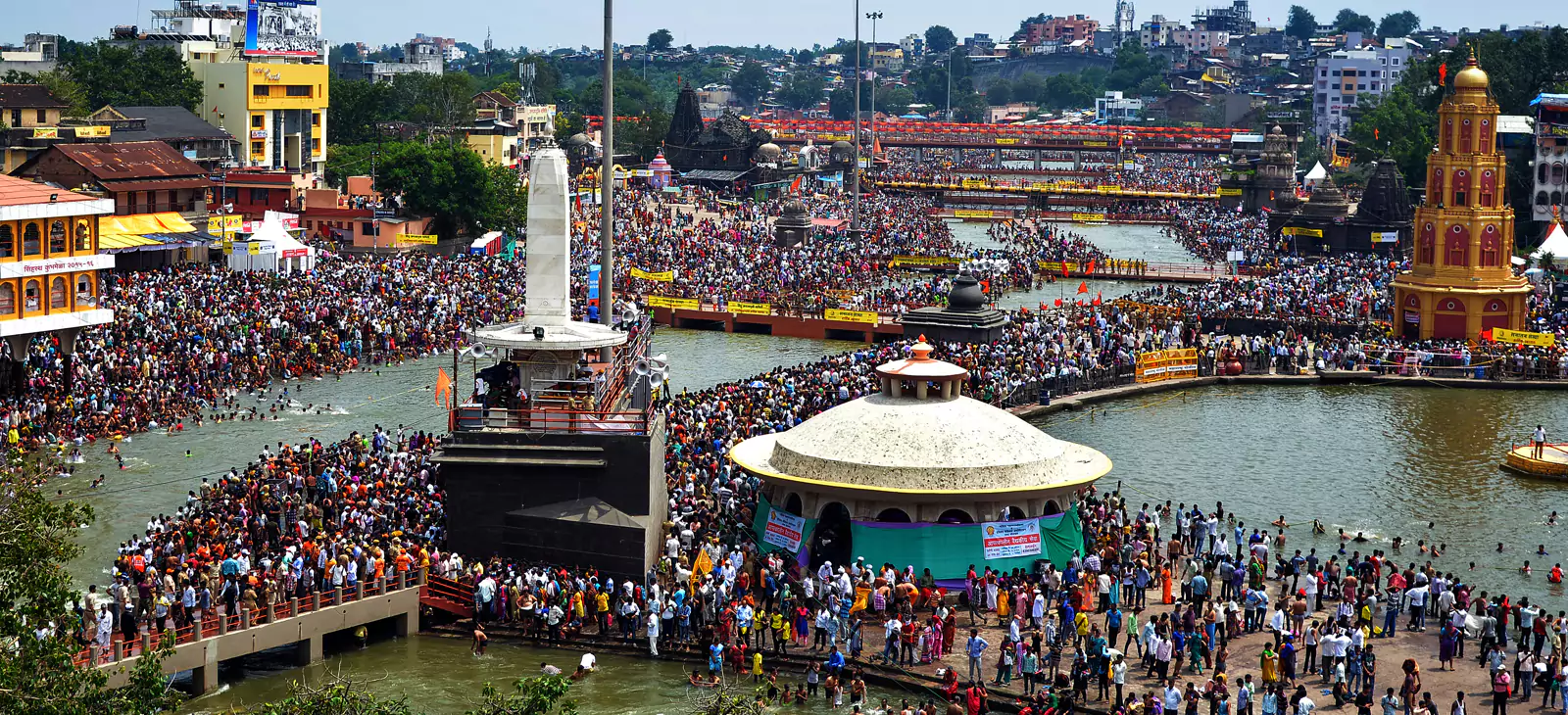
This ancient bathing ghat on the Godavari is perhaps the most storied spot in Nashik. Hindu tradition holds that Lord Rama himself bathed at Ramkund during his fourteen-year exile, lending the water here an almost mythological sanctity. During the Kumbh, this is where the Vaishnava Akharas — followers of Lord Vishnu — conduct their Amrit Snan rituals. The Panchavati area surrounding the ghat is rich with Ramayana heritage and is dotted with temples that make for a deeply immersive spiritual walk.
Kushavarta Kund, Trimbakeshwar
About 28 km from Nashik city lies Trimbakeshwar, home to one of India’s twelve sacred Jyotirlingas — the Trimbakeshwar Shiva Temple. The Kushavarta Kund here is believed to be the symbolic origin point of the Godavari River, and it is here that the Shaiva Akharas — devotees of Lord Shiva — perform their royal dip during Simhastha. A visit to the Jyotirlinga temple is an inseparable part of any Trimbakeshwar pilgrimage.
Key Rituals and Traditions at Simhastha
Amrit Snan — The Royal Bath
The crowning ritual of the Nashik Kumbh. Processions of Naga Sadhus and saints from the Akharas move through the streets in a spectacle of faith before descending into the Godavari. Witnessing this is to witness living history — centuries of unbroken tradition played out in real time.
Nagar Pradakshina
Scheduled for July 29, 2027, this sacred circumambulation of Nashik city is a ritual procession where saints and devotees walk around the holy perimeter of the town in an act of collective devotion and blessing.
Pravachans and Kirtans
Throughout the Mela period, saints, scholars, and spiritual leaders hold discourses (pravachans) and devotional singing sessions (kirtans) at various points in the Mela grounds. These gatherings are open to all and form the soul of daily life at the Kumbh.
Pind Daan and Ancestor Rituals
Nashik holds particular importance as a site for ancestral rites (Pind Daan). Many pilgrims combine the Kumbh visit with these rituals, believing the confluence of the Simhastha energy and the sacred Godavari grants liberation (moksha) to departed souls.
How to Reach Nashik for Kumbh Mela 2027
By Air
Nashik’s Ozar Domestic Airport connects the city to Mumbai and other major Indian cities. Alternatively, Mumbai’s Chhatrapati Shivaji Maharaj International Airport (CSMIA) — approximately 170 km away — offers far more flight options. From Mumbai, buses, taxis, and shared cabs run regularly to Nashik.
By Train
Nashik Road Railway Station is the main railhead. Trains from Mumbai (Nasik Road Express, Panchavati Express), Pune, Aurangabad (Devgiri, Tapovan), and other cities connect here regularly. Book well in advance of peak Amrit Snan dates, as trains fill up quickly.
By Road
Nashik sits at the junction of NH3 and NH60, making it easily accessible by road from Mumbai (approx. 170 km), Pune (approx. 210 km), and Aurangabad (approx. 190 km). State-run MSRTC buses and private operators run frequent services. Note that vehicle restrictions around the outer ring road apply on peak Amrit Snan days — always check local advisories before driving in.
Accommodation in Nashi Kumbh Mela Guide
With 15–20 crore devotees expected over the Mela period, accommodation in Nashik and Trimbakeshwar will be in extremely high demand. Here is how to plan:
- Book early — at least 3–6 months before the Amrit Snan dates you plan to attend.
- Hotels in Nashik city range from budget lodges to comfortable mid-range properties near Panchavati.
- Dharamshalas (pilgrim rest houses) near the temples offer economical stays for budget travellers.
- The Maharashtra Tourism Development Corporation (MTDC) and the Divisional Commissioner’s office are expected to publish lists of approved accommodation providers closer to the event — always book through verified platforms to avoid unauthorized agents.
- For Trimbakeshwar, accommodation options are limited, so many pilgrims choose to stay in Nashik and travel the 28 km daily.
- The Mela spans over 21 months, so if the peak dates feel too daunting, you can plan a visit during the quieter windows and still experience the full sanctity of Simhastha.
Essential Pilgrim Tips from Adhvanta
- Plan your travel around the official Amrit Snan dates but consider arriving a day or two before the main crowds peak.
- Authorities have implemented dedicated vehicle-free zones near the ghats on Snan days — use park-and-ride systems and designated shuttle services.
- Carry sufficient water, especially during August and September when Nashik can be humid and warm post-monsoon.
- Dress modestly and wear comfortable footwear that can be easily removed at temple entrances.
- Keep emergency contacts and your accommodation address written down or saved offline — mobile networks can be unreliable at peak crowd times.
- Medical camps, police checkpoints, and first-aid stations will be set up across the Mela grounds. Locate these near your accommodation on arrival.
- Eco-friendly initiatives are being planned by the Maharashtra Government. Avoid single-use plastics and dispose of waste responsibly.
Why Nashik Kumbh Mela 2027 Belongs on Your Bucket List
There are events, and then there are experiences that change you. The Nashik Simhastha Kumbh Mela is the latter. To stand at Ramkund as the first light of an August dawn breaks over the Godavari, to hear the conch shells of the Akharas echo through Panchavati, to immerse yourself in waters that millions of souls before you have called sacred — this is not tourism. It is transformation.
With the official Amrit Snan dates announced, the Maharashtra Government mobilised, and over 15 crore devotees expected to gather over the course of the Mela, the 2027 Simhastha promises to be one of the most extraordinary spiritual events of this decade.
Start planning your Adhvanta pilgrimage now. The Godavari awaits.